How I Work
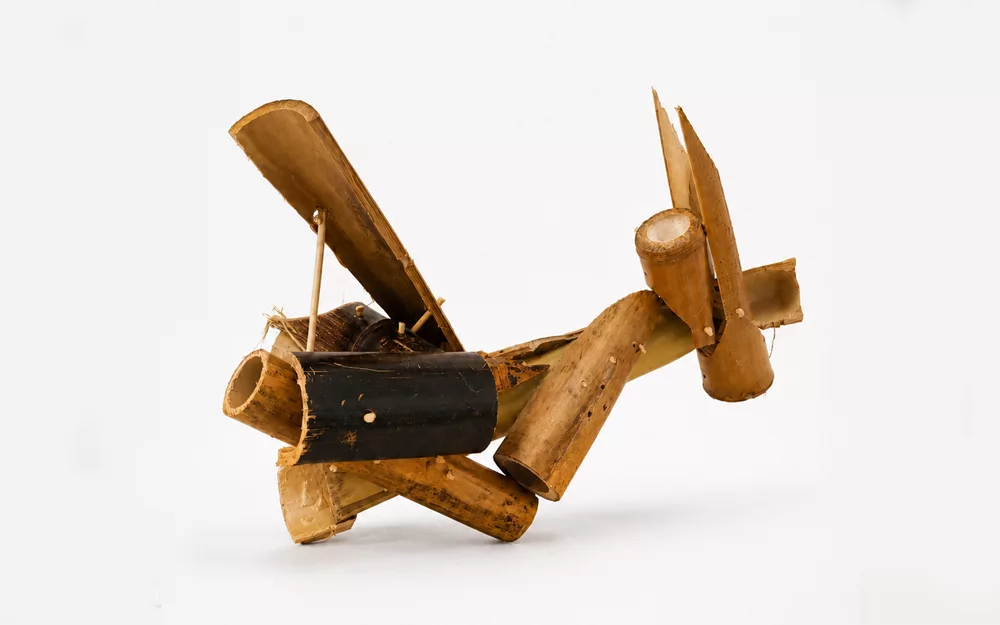
When I make a work, there’s not usually a clear image in my head. What happens instead has to be improvised: a bamboo split bends differently than expected or a joint doesn’t hold. Reversals, hesitations and breakages are all part of the game.
There’s a strong tendency to assume the opposite: that objects begin as ideas in the mind of a creator, and are then acted out into the world. A sculpture, a chair, a building: they appear coherent, resolved, intentional. Easy to imagine they were always that way.
I felt for a long time that this is what I ‘should’ do. But:
a/ I slowly came to realise it was not a realistic view of how my work comes into being. Bamboo resists any specific ‘idea’ through its natural characteristics. It’s impossible to just do what I want (try as I might).
b/ it’s not a realistic view of how the world works either. As anthropologist Tim Ingold suggests, artefacts are not the execution of prior plans so much as traces left behind by an ongoing process – temporary stabilisations in a continuous flow.
Lots of things go into how I work which are beyond a simple idea. Things like memory (how a joint worked last time), and knowledge (what should hold, what should bend). And just as important but harder to pin down: the feel of the material, the moment when resistance gives slightly, or doesn’t.
Paul Klee wrote “form is the end, death; form-making is life.” The moment something settles into a final shape, the movement that produced it has already passed.
And Henry Moore said it more poetically: “The thinking hand discovering the thoughts of the material”.
But even then, it doesn’t really stop.
Bamboo dries, cracks, softens. Pieces are moved and recontextualised, or seen differently under different light. What looked finished changes under new conditions.
Andy Goldsworth has said: “Nothing lasts. We all have to deal with loss. When I make something, in a field or street, it may vanish but it’s part of the history of those places. In the early days my work was about collapse and decay. Now some of the changes that occur are too beautiful to be described as simply decay.”
Each contingency accumulates the next.
By the time one of my pieces is complete, it might look as though it must have been planned from the start, but that’s a kind of illusion. What’s actually there is a record of decisions, adjustments, responses, and rethinking. The coherence of the final form hides the contingency of how it came into being.